How body insecurity influences the decision to go to a massage center
2026-04-23 11:16:00
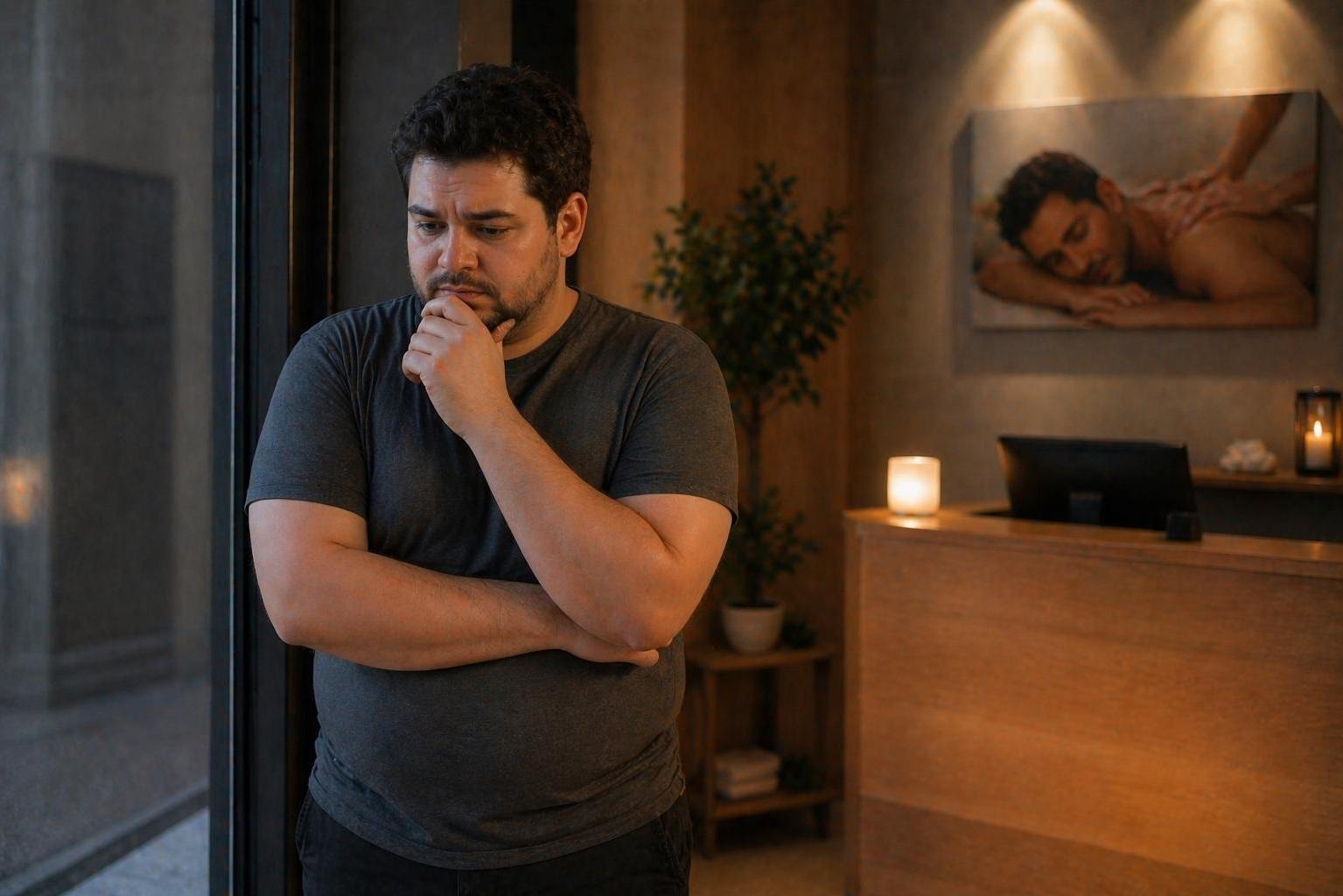
Before dialing a phone number, before sending a WhatsApp message, there's a moment of doubt that many men know all too well. It's not doubt about the establishment, the price, or whether the service will be professional. It's something more basic, more uncomfortable to admit: the feeling that their own body isn't living up to what they imagine is expected of them.
That thought comes up far more often than it's talked about. "Haven't I gained too much weight?" "At my age, is it even worth going?" "My belly, my stretch marks, my body?" Male body insecurity in the context of erotic massage is a real obstacle that affects many men's decisions. And almost no one talks about it openly.
The body as an imaginary barrier
Most men who go to an erotic massage parlor don't have the body they imagine is "expected" of them. And that includes those who have been going for years, those going for the first time, and those who still don't go precisely for that reason. Men in their forties, fifties, with bellies, with baldness, with scars, or simply with the visible accumulation of years lived on a real body.
The problem isn't the body. The problem is the image each person constructs of their own body based on years of very specific messages about how a man should look to be desirable in an erotic context. These messages come from everywhere: porn, advertising, comments you remember without quite knowing when or where they came from.
The barrier that this process creates can be as real in its effect as if it existed physically. There are men who spend months thinking about going and never take the step because body insecurity comes before desire and paralyzes them.
Where does that inhibition in men come from?
There is something specific about how men construct their relationship with their own bodies in the context of sexuality. For many years, the male body has not been culturally treated as an object of attention or care, but as a tool for performance. A body that functions, that endures, that produces results. Not a body that is cared for, that is observed, that is inhabited with awareness.
When a man reaches midlife and discovers he wants to care for his body differently, a shame often arises alongside this desire, a shame that doesn't quite fit with what he feels. It's not moral shame. It's the shame of exposing himself, of being seen, of taking up space with a body that hasn't been properly examined for too long.
In the context of gay massage, this intersects with another layer. Body image within the community has its own pressures and hierarchies. A man who no longer fits the youthful, defined ideal may feel that this space isn't for him either, that he'll be judged in some way, that something in the encounter will confirm what he already feared about his own body. Although this varies greatly from person to person, and not all men feel this pressure with the same intensity.
What happens in the reality of the center
What almost no one explains before going is that a professional massage therapist does not see the client's body in the same way that the client sees himself.
A professional works with real bodies, all kinds of bodies, every day. They don't judge weight, height, age, or marks because that's not part of their job. Their job is to work with that body with respect, technique, and full presence. What the client perceives as imperfection, the massage therapist simply sees as the body of a person who is there to be treated well.
This is something many men only understand after their first visit. There's something about that first session—the touch, the complete absence of judgment, the fact that nothing they feared came to pass—that redefines their relationship with their own body. It's not magic. It's simply the experience of being treated well in a body they haven't treated well in a long time.
The insecurity that remains after the first step
Going once doesn't eliminate male body image issues overnight. Some men find the second or third visit much easier than the first precisely because they know firsthand that the obstacle holding them back wasn't as significant as they imagined. Others take longer to let go of that burden.
What does change frequently is the intensity of the inhibition. After a first positive experience, the obstacle of body image loses real weight in decision-making. It's still there in the back of your mind, because these things don't disappear overnight. But it no longer has the power to block the decision before it even begins.
It is also common for that first experience to trigger something broader. Men who have had a complicated relationship with their own bodies for years sometimes describe a kind of permission they give themselves afterward, a different disposition toward being in their bodies that they didn't have before entering them for the first time.
Real bodies in spaces designed for pleasure
An erotic massage parlor is not a gym. There are no mirrors, no visible comparisons, no hierarchy of bodies, and no one evaluating anything. It is a space designed for the body to be cared for, not judged.
That applies to all bodies. To the one who hasn't exercised regularly in twenty years. To the one whose back is covered in marks. To the one who weighs more than he'd like, or to the one whose body hasn't always been easy. Body insecurity isn't a requirement for entry or a reason for exclusion. It's, at most, an inner turmoil that many men bring with them and that, in the vast majority of cases, quiets down well before the first session is over.
The body you have is the body you are with. And it's the only body you can enter with. That, though it may seem obvious, is exactly what the space of massage gives you back in a practical way.